|
|
Aristotle (Aristoteles) (Greek: Αριστοτέλης; Αριστοτέλης ο Σταγειρίτης (384 BC 7.3. 322 BC), philosopher, scientist (The Master of those who know), brother of Arimnestus and Arimneste. The man was born, he worked, and then died. Martin Heidegger, German philosopher, A short biography of Aristotle presented in a lecture.
Aristotle was born at Stageira (or Stagira) on the peninsula Chalcidice. His parents were the physician Nicomachus (working for the Macedonian King Amyntas II) and Phaestis (his mother who died when he was a child). At the age around ten also his father died and the orphan Aristotle lived with his uncle Proxenus of Atarneus who was also his teacher in rhetoric and poetry. At the age of 18 he went to Athens where he was a student of Plato working later in the Academy until the death of his teacher. Probably he was dissapointed that not he but Speusippus, the nephew of Plato, was appointed as the next director of the Academy after Plato and so he left Athens and he went to the court of Hermias in Asia Minor. There he worked for around three years until the death of Hermias of Atarneus. He went for 1-2 years to Lesbos (where he did some biological research) and returned to Stageira after King Philip II asked him to work as a teacher of his son Alexander the Great (343 BC). Aristotle returned to Athens after Alexander started his expedition against Persia. He opened a school in Athens which was dedicated to Apollo Lykeios and for this reason known as the Lyceum (also known as the Peripatic School because Aristotle prefered to discuss problems walking with his students and others). After the death of Alexander the Great he left Athens since some Athenians were against Alexander and again Aristotle who was supported financially by Alexander. Aristotle went to Chalkis / Euboea (the birthplace of his mother), where he died one year later. His original books, written mainly in the period of the Lyceum, some in the form of dialogues, all lost. His work is mainly from lecture notes compiled by his students. For some period these written manuscripts were hidden by Neleus and his family (in order to prevent to be taken by the Attalids of Pergamon for their libraries) in a vault, or a cellar (together with the works of Theophrastus) in Scepsis. With some modifications almost 2 centuries after his death a collection, known as Corpus Aristotelicum published that contains probably also some additional work of students of his school. Aristotle had a child, Nicomachus, with Herpyllis, his second wife after his first wife Pythias, the niece of Hermias, died during the Lyceum years. Reading the parts of his work that survived we understand why Aristotle was one the most important universal scientists of all time (if not the most important). His work was almost forgotten because his ideas about God (The unmoved mover) were not conformal to Christian religion as that of Plato. Around the 12th century again he was rediscovered and his work was recognized and scholars transformed his ideas almost into a religion. The irony is that Aristotle was considered responsible that his wrong ideas delayed the development of science. The scholars did not apply the method of Aristotle to start with a review of the work of others with comments which ideas and why are wrong, a method usually followed in every scientific publication today. Most of his errors (but not only) were about physical /natural phenomena. Only more than 1500 years after Aristotle's death real experiments were performed.
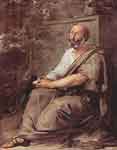
Aristotle of Stagira (384 - 322 BC) (according to Dante Alighieri "The Master of those who know") stretches his hand. He holds a copy of his Nichomachean Ethics -- and he indicates with his gesture the worldliness, the concreteness, of his contributions to philosophy. School of Athens Work of Aristotle Part of the lectures notes, remain of an estimated 400 - 1000 works of Aristotle (dialogues) all lost. NATURAL SCIENCE Physics (Φυσικὴ ἀκρόασις), translated by R. P. Hardie and R. K. Gaye (The four Causes , Physics - Book II.3 ) On Heavens (Περὶ οὐρανοῦ)(De Caelo) translated by J. L. Stocks Meteorology (Μετεωρολογικά)(Meteorologica) translated by E. W. Webster On the Generation and Corruption (Περὶ γενέσεως καὶ φθορᾶς)(De Generatione et Corruptione) translated by H. H. Joachim, Info The History of Animals (Περὶ τὰ ζῶια ἱστορίαι)(Historia Animalium), translated by D’Arcy Wentworth Thompson On the Motion of Animals (Περὶ ζώιων κινήσεως), translated by A. S. L. Farquharson On the Gait of Animals (Περὶ πορείας ζώιων), translated by A. S. L. Farquharson On the Parts of Animals (Περὶ ζώιων μορίων), translated by William Ogle On the Generation of Animals (Περὶ ζώιων γενέσεως), translated by Arthur Platt On youth and old age, on life and death, on breathing, (Περὶ νεότητος καὶ γήρως, περὶ ἀναπνοῆς) translated by G. R. T. Ross On Longevity and Shortness of Life (Περὶ μακροβιότητος καὶ βραχυβιότητος), translated by G. R. T. Ross On Memory and Reminiscence (Περὶ μνήνης καὶ ἀναμνήσεως) , translated by J. I. Beare On the Soul (Περὶ ψυχῆς) (De Anima) translated by J. A. Smith On Sense and the Sensible (Περὶ αἰσθήσεως καὶ αἰσθητῶν)(De Sensu et Sensibilibus) translated by J. I. Beare On Dreams (Περὶ ἐνυπνίων)(De Insomniis) translated by J. I. Beare On Sleep and Sleeplessness (Περὶ ὕπνου καὶ ἐγρηγόρσεως), translated by J. I. Beare On Prophesying by Dreams (Περὶ <ῆς καθ᾽ ὕπνον μαντικῆς), translated by J. I. Beare
Aristotle tutoring Alexander by J L G Ferris 1895 Aristotle on being told that a person had been abusing him in his absence: “He may even beat me, if he likes, in my absence.” Being asked how we should treat our friends, he replied, “As we should wish our friends to treat us.” And to one who inquired how students should get on, he said, “Pressing on upon those who are before and not waiting for those who are behind.”
Aristotle, Monastery Filanthropinon The Probable Nature and extent of Aristotle's Dissections METAPHYSICS Metaphysics, (Τὰ μετὰ τὰ φυσικά) translated by W. D. Ross (called Metaphysics because it was a book after "meta" the books of physics, Aristotelian view of God , Info about Metaphysics LOGIC ( Organon ) Categories (Κατηγορίαι) translated by E. M. Edghill, Info On Interpretation (Περὶ ἑρμηνείας), translated by E. M. Edghill, Info Prior Analytics (Ἀναλυτικὰ πρότερα) translated by A. J. Jenkinson (definition of syllogisms BOOK I) Posterior Analytics, (Ἀναλυτικὰ ὕστερα) translated by G. R. G. Mure Topics (Τοπικά) translated by W. A. Pickard-Cambridge On Sophistical Refutations (Περὶ σοφιστικῶν ἐλέγχων), translated by W. A. Pickard-Cambridge
ETHICS Nicomachean Ethics (Ἠθικὰ Νικομάχεια), translated by W. D. Ross, (Phronesis) Perseus Texts Eudemian Ethics (Ἠθικὰ Εὐδήμεια) AESTETHIC The outlying villages, they say, are by them called komai, by the Athenians demoi: and they assume that comedians were so named not from komazein, "to revel," but because they wandered from village to village (kata komas), being excluded contemptuously from the city.... The same distinction marks off Tragedy from Comedy; for Comedy aims at representing men as worse, Tragedy as better than in actual life. Aristotle Poetics Poetics, (Περὶ ποιητικῆς) translated by S. H. Butcher (Only a part survived) Rhetoric, (Ῥητορικὴ τέχνη) translated by W. Rhys Roberts POLITICS Politics (Πολιτικά) translated by Benjamin Jowett (Only a part survived) Perseus Texts The Athenian Constitution (Ἀθηναίων πολιτεία),
The "moved" mover Aristotle's Potential and Actual Infinite and Cantor Aristotle's Syllogism : Logic takes form , A more advanced description of Aristotle on Mathematics, Logic (from Stanford University) , Aristotle: political theory (Stanford) Aristotle: psychology (Stanford) Aristotle Metaphysics (Stanford) Aristotle and Astronomy (The Prime Mover), Physics and Metaphysics Why probably America was discovered Aristotle and some of his remarkable observations Aristotle a Reason that Physics did not advance for centuries? , Continuity and the Void Aristotle on the Generation of Animals with emphasized text parts Ancient Anatomy, including Aristotle D’Arcy Wentworth Thompson and Charles Singer, Natural Science, Biology (Legacy of Greece) Aristotle on Sperm Competition in Birds (pdf) Aristotle from the Catholic Encyclopedia The Early Greek Concept of the Soul Whatever Happened to the Soul? Scientific and Theological Portraits of Human Nature
Aristotle, 5 Drachmae Coin 1976 Harvard University Press: Loeb Classical Library
Stanford Encyclopedia of Philosophy

![]() |
|
||||||||||||||||||